Nissan CVT gearboxes: what goes wrong and how to avoid it
Most automatic Nissans imported into Kenya — the Note, X-Trail, Wingroad, Juke, March, Sylphy, Serena and Dualis — use a CVT, which Nissan calls Xtronic. It’s smooth and economical, but it’s sensitive to old fluid and heat, and repairs are costly.
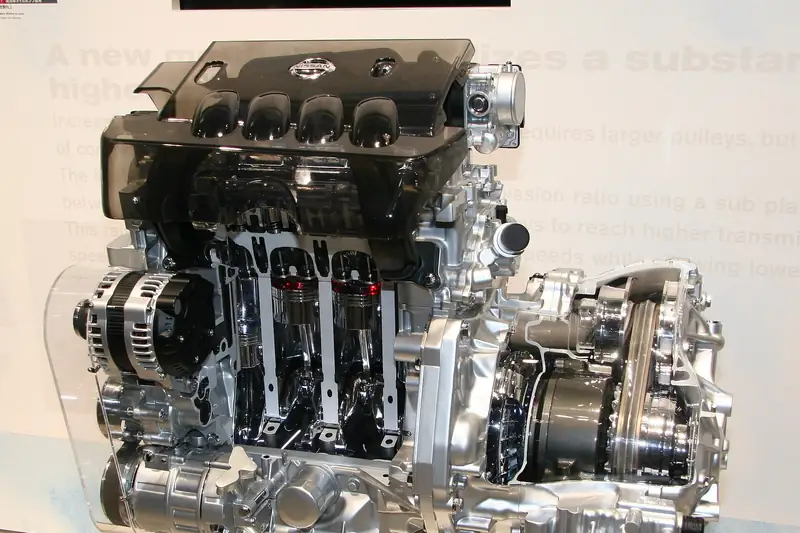
Photo: TTTNIS · Public domain, Wikimedia Commons
How a CVT works
Instead of fixed gears, a CVT uses a steel belt between two pulleys that change size, so the engine always runs at its most efficient speed. That’s why a CVT car feels seamless and saves fuel — and why the belt and pulleys depend on clean, correct fluid.
What goes wrong
- A shudder or judder when pulling away gently.
- A whine or hum that rises with speed.
- The revs flaring without the car speeding up (slipping).
- Limp mode or a warning light after a long climb or a hot day in traffic — the CVT has overheated.
Why it happens
Mostly old fluid, the wrong fluid, or overheating from heavy loads, long steep climbs, towing and hard driving. Nissan CVTs need Nissan’s own CVT fluid (NS-2 or NS-3, depending on the car) — a general automatic fluid can damage them.
How to make it last
Change the CVT fluid regularly with the correct Nissan fluid — many specialists recommend every 40,000–60,000 km in Kenyan conditions — avoid towing or overloading, and on long climbs like Mai Mahiu use L or the manual mode if the car has one. If a CVT does fail, reconditioning is often cheaper than a new unit.
What to check before you buy
- Pull away gently from a standstill several times: there should be no shudder.
- Drive up a hill and at highway speed: no whine and no slipping.
- No CVT or engine warning lights — ask a mechanic to scan for gearbox codes.
- Ask when the CVT fluid was last changed, and with which fluid.
Models this applies to
- Nissan Note — 78 hp, 2014–2019
- Nissan X-Trail — 145 hp, 2014–2019
- Nissan Wingroad — 109 hp, 2005–2018
- Nissan Juke — 114 hp, 2010–2019
- Nissan March — 79 hp, 2010–2021
Frequently asked questions
Are Nissan CVTs reliable?
They’re reliable when the fluid is changed on time with the right Nissan fluid and the car isn’t overheated. A neglected CVT is the most common expensive repair on used Nissans, so check the history and test it well.
How often should I change Nissan CVT fluid?
Many specialists recommend every 40,000–60,000 km for cars driven in heat, hills and heavy traffic. Always use the Nissan CVT fluid specified for the car.
Why does my Nissan CVT shudder?
Shudder usually comes from worn fluid or early wear inside the CVT. A fluid change with the correct fluid sometimes cures it; if not, have a gearbox specialist check it before it gets worse.
Keep reading
- Mazda SkyActiv engines: common problems and how to avoid them
- Subaru CVT and boxer engines: reliability and maintenance in Kenya
- Toyota VVT-i and Valvematic engines: common issues and fixes
- Hybrid cars in Kenya: battery lifespan, warning signs and replacement
- Modern diesels in Kenya: DPF, injector and turbo problems