Mazda SkyActiv engines: common problems and how to avoid them
Mazda’s SkyActiv engines power almost every Mazda imported into Kenya since about 2012 — the Demio, Axela, Atenza, CX-3 and CX-5. The petrol engines are efficient and generally reliable. Most problems Kenyan owners report come down to three things: the wrong battery, overdue or wrong oil, and diesels that spend their lives on short town trips.
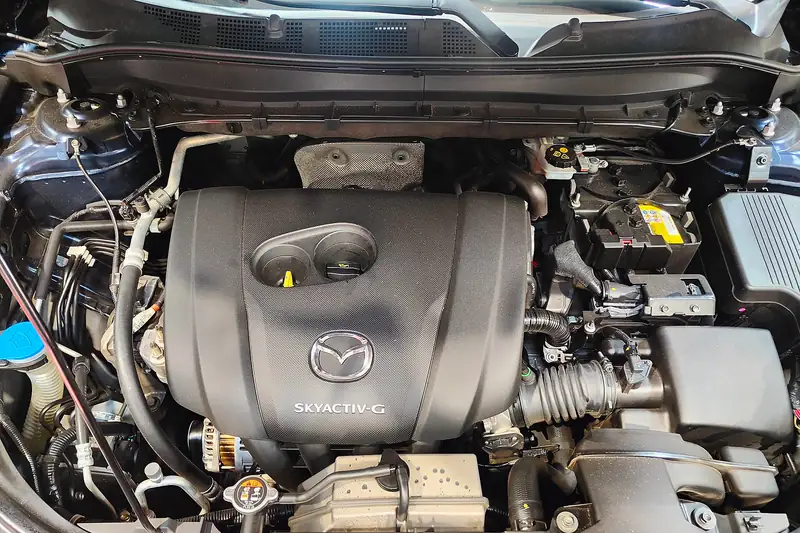
Photo: Iamjosemom · CC BY 4.0, Wikimedia Commons
What “SkyActiv” means
SkyActiv is Mazda’s name for the engines, gearboxes and bodies it introduced from 2011. SkyActiv-G is the petrol engine (high compression, direct injection), SkyActiv-D is the twin-turbo diesel, and SkyActiv-Drive is a conventional six-speed automatic gearbox — not a CVT.
SkyActiv-G petrol: mostly about the battery
Most SkyActiv petrol cars have i-stop, which switches the engine off at the lights. It needs a specific enhanced battery (EFB or AGM, in the size listed in the owner’s manual). Fit an ordinary battery and i-stop stops working, warning lights flash and the battery dies early — a very common complaint in Kenya that often gets blamed on the engine.
Like all direct-injection engines, high-mileage SkyActiv-G engines can collect carbon on the intake valves, which shows up as a rough idle. Good fuel, regular longer drives and on-time oil changes keep it at bay.
SkyActiv-D diesel: soot, oil dilution and short trips
The 2.2 diesel (CX-5, Atenza) and 1.5 diesel (Demio, CX-3) have a diesel particulate filter (DPF) that burns off soot on longer, faster drives. A life of short Nairobi trips stops that from happening: the DPF warning comes on, fuel can end up in the oil — so the oil level rises instead of falling — and soot builds up in the intake.
Give a diesel a steady highway drive of 20–30 minutes every week or two, use the low-ash diesel oil Mazda specifies, and check that the oil level isn’t climbing above the maximum mark. If you mostly drive short trips in town, the petrol version is the safer buy.
The gearbox
SkyActiv-Drive is a conventional torque-converter automatic and is generally tough. Mazda treats its fluid as long-life in many markets, but changing it around every 60,000–80,000 km is cheap insurance for a car that works hard in traffic and hills.
What to check before you buy
- Warm the engine and wait at idle: i-stop should switch it off. If it doesn’t, ask when the battery was last replaced and whether it’s the right type.
- No flashing i-stop, battery or engine lights on the dashboard.
- Diesels: ask how it was driven, check the oil isn’t above the maximum mark, and watch for DPF or engine warnings.
- Ask for service records showing the correct oil and filter changes.
- On the test drive, gear changes should be smooth, with no flare or thump.
Models this applies to
- Mazda Demio — 91 hp, 2015–2019
- Mazda CX-5 — 153–187 hp, 2015–2020
Frequently asked questions
Are Mazda SkyActiv engines reliable?
The SkyActiv-G petrol engines are generally reliable when they get the right battery and on-time oil changes. The SkyActiv-D diesels are good engines too, but they need regular longer drives to keep the particulate filter clean — short town trips cause most of their problems.
Why does my Mazda i-stop not work?
Usually the battery: i-stop needs the enhanced (EFB or AGM) battery specified for the car, in good health. An ordinary or weak battery switches i-stop off and can bring on warning lights.
Is the Mazda CX-5 diesel good for Nairobi traffic?
Only if it also gets regular highway drives. For mostly short trips in town, the 2.0 or 2.5 petrol CX-5 is the safer choice.
Keep reading
- Subaru CVT and boxer engines: reliability and maintenance in Kenya
- Toyota VVT-i and Valvematic engines: common issues and fixes
- Nissan CVT gearboxes: what goes wrong and how to avoid it
- Hybrid cars in Kenya: battery lifespan, warning signs and replacement
- Modern diesels in Kenya: DPF, injector and turbo problems